Indivisible Polk Foothills
Making It Easier to Show Up in Polk County
Listening to a volunteer steering committee, then reorganizing the information their neighbours needed — a restructure, a rewrite, a custom Google Sites theme, a calendar that tells the truth, and a guide the group runs it from.
- 5
- Pages, down from eleven
- 1,000
- Business cards kept in service
- 0
- JavaScript in the calendar
Indivisible Polk Foothills is a non-partisan civic group in Polk County, North Carolina — Columbus, Tryon, and Saluda — run by a volunteer steering committee whose members skew older. Their website was eleven pages of Google Sites, and it was working against them.
The committee already knew what their neighbours needed to hear. What they did not have was a site that carried it. Most of this project was listening to them describe how people actually turn up — who asks what, what puts someone off, what a first night feels like — and then arranging the information so it did that work instead of getting in the way.
The challenge
Four of the eleven pages were empty or held nothing but a quotation. The “Elected Officials” page had been empty since launch. The home page carried a genuinely useful weekly events bulletin, buried below a wall of nine quotations about democracy. A watermarked stock graphic sat on the public home page with the words “DESIGN ZEN” visible across it.
The bare domain did not resolve, so the site had to tell visitors to type “www” in front of the address before it would load.
Underneath all of that was a subtler problem. The writing had been inherited from national Indivisible’s mobilizing register — urgent, adversarial, built for a movement. Read in a county of three small towns, where the person on the other end is a neighbour who might turn up to one meeting to see what it is like, it was the wrong voice entirely.
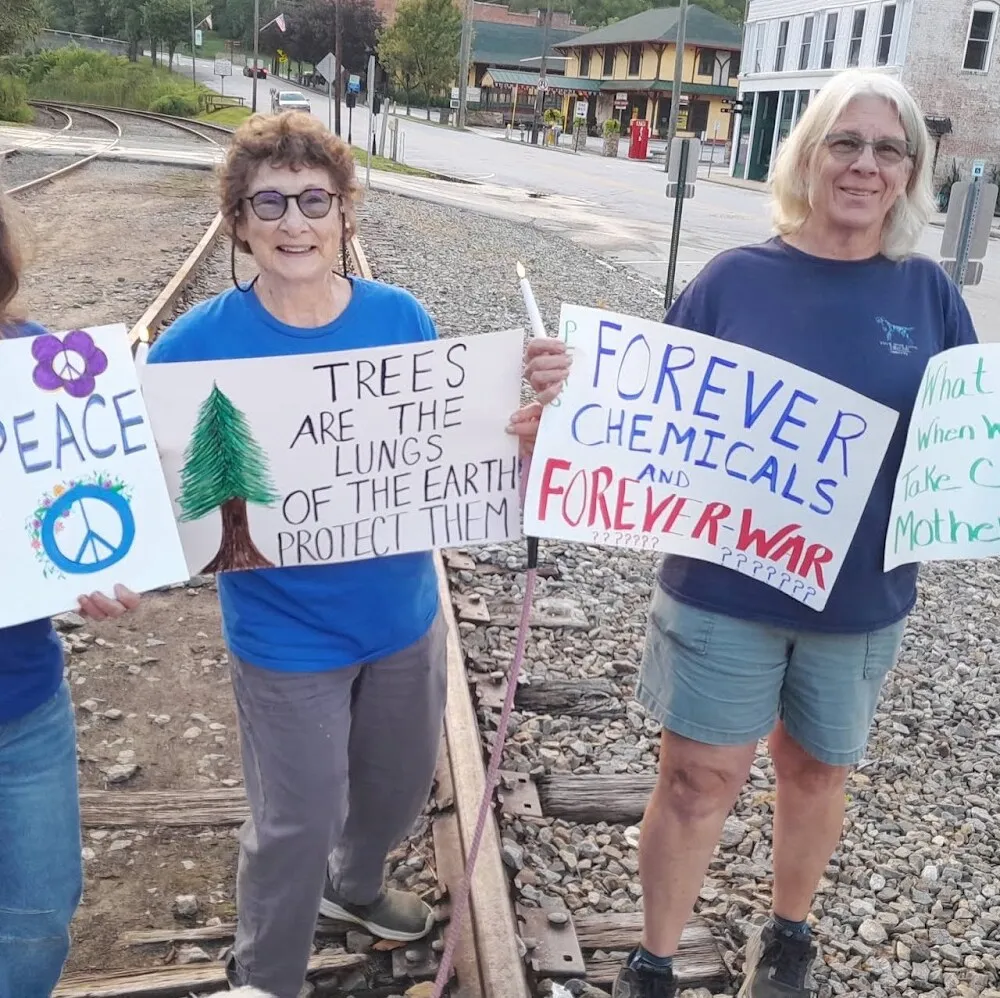
And there were two usable photographs for the whole site.
What we did
Every page was audited, and the ones carrying nothing were folded into the ones that were. What survived is a site where each page has a job and something on it, arranged in the order someone actually needs it: what is happening, how to vote, who we are, how to join.
Before anything on the live site moved, I built the whole thing as a working HTML model — real type, real colour, real content — so the steering committee could agree on the direction by looking at it rather than imagining it. Every page’s copy was rewritten. Then a custom Google Sites theme carried the real typography and the exact brand colours onto the platform, which most people assume Sites will not do.
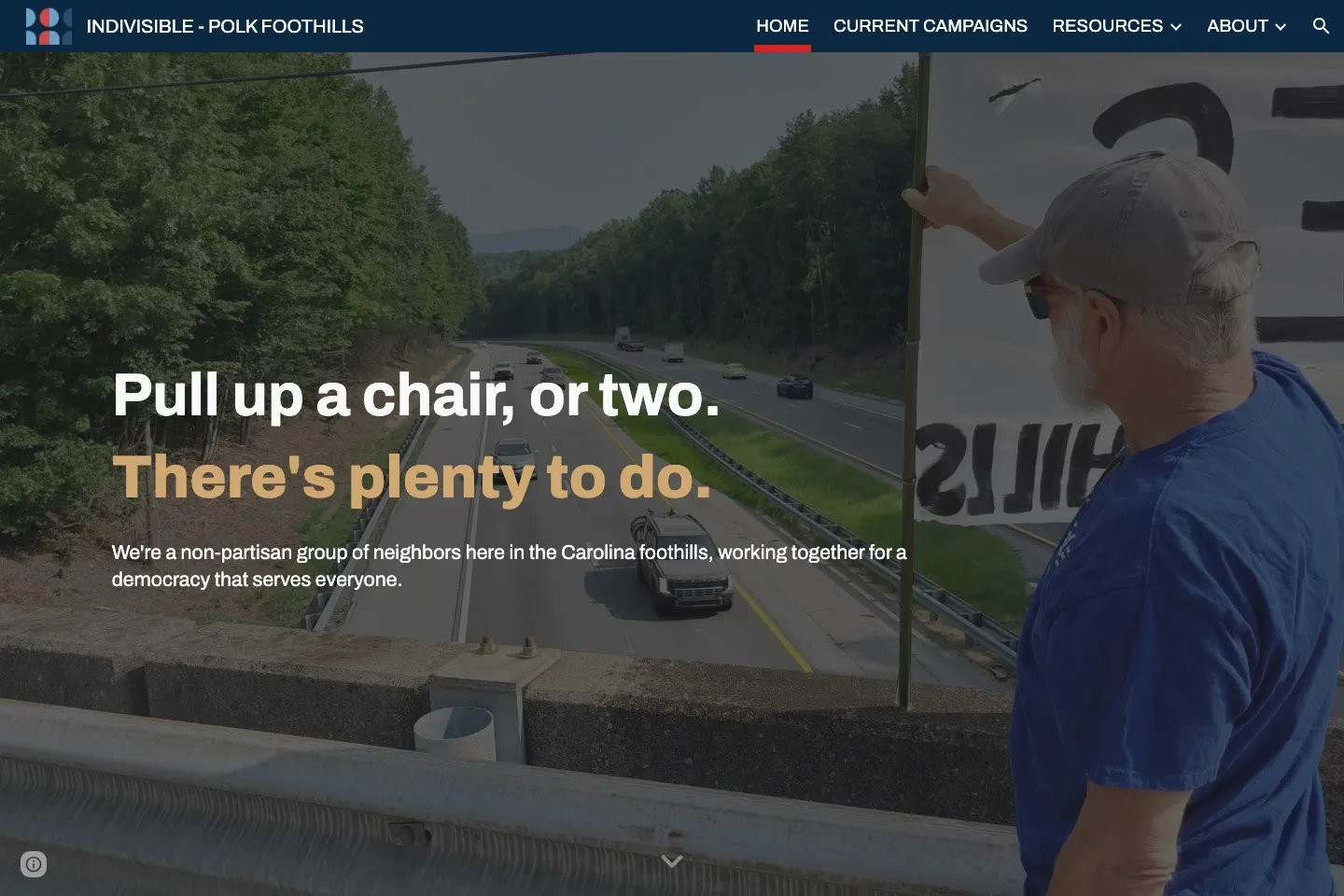
The model is where the design was settled, not where it was delivered. Google Sites has no import — you cannot hand it a page and have it build one. So the approved design was reconstructed inside the editor by hand, block by block, with each section rebuilt from the components Sites actually offers and the theme doing the work the platform’s own styling would otherwise have done. Comparing the two images below is comparing a drawing to the building.
The palette came from the county rather than from a flag: foothill petrol, cardboard kraft, and the red of a marker on a hand-lettered sign. Hard-edged modules, square corners, no drop shadows — poster board rather than web cards. With two photographs available, the design had to hold up mostly without pictures, so it does.
Staying on Google Sites was the point
Rebuilding this somewhere else would have been easier for me and worse for them. A custom site means a bill every month and a developer on call — and for a volunteer group running on donations, both are the wrong answer. It also means that the day someone needs to post a meeting change, they wait for me.
Google Sites is free, it comes with the account they already have, and a volunteer can edit a page in a browser without learning anything new. So the work went into making Sites do more than people expect it to: a real theme with proper typography and the exact brand colours, and a calendar that behaves, rather than a new platform nobody in the group could run.
That decision is why the last deliverable matters as much as the first.
The calendar that would have been wrong half the year
The county’s meetings had been imported into the group’s calendar as fixed UTC instants with no timezone attached. Because each recurrence was anchored to a moment in UTC rather than to five o’clock local time, every meeting would have displayed an hour off for half of each year. Each one also appeared twice, since the county publishes the same meeting on several internal sub-calendars.
I read it out of the raw .ics, rebuilt the series as timezone-anchored
recurring events, and verified the fix by expanding every series across both
daylight-saving boundaries.
On top of it sits a calendar widget with no JavaScript in it: a visitor switches between the group’s own events, Polk County government meetings, or both, in list or month view. Nothing to break, and nothing for a volunteer to maintain.
A thousand business cards, saved by one setting
The group had printed a thousand cards whose QR code pointed at a page the restructure had renamed. Decoding the code confirmed it was static — the URL is the pattern itself, so there was no redirect to repoint and the designer could not help. Restoring the old path on the site brought every card back to life. No reprint.
Writing for the room, not for the movement
“To galvanize Polk County voters to vote in the fall mid-term elections” became “Get Polk County to the polls.”
The rewrite worked on a single premise: the reader is not asking what democracy means. They are asking whether they will have to speak, whether they will know anyone, and whether they will be judged for how they have voted before. Three sentences do most of the recruiting — that none of the ways in require you to say anything, that nobody gets handed a clipboard on their first night unless they ask for one, and that you are welcome whatever you have voted before.
Results
The site is five pages instead of eleven, every one of them with something on it. The events bulletin is the first thing on the home page rather than the last. The county calendar shows the right time in both halves of the year, once per meeting. The thousand cards still work.
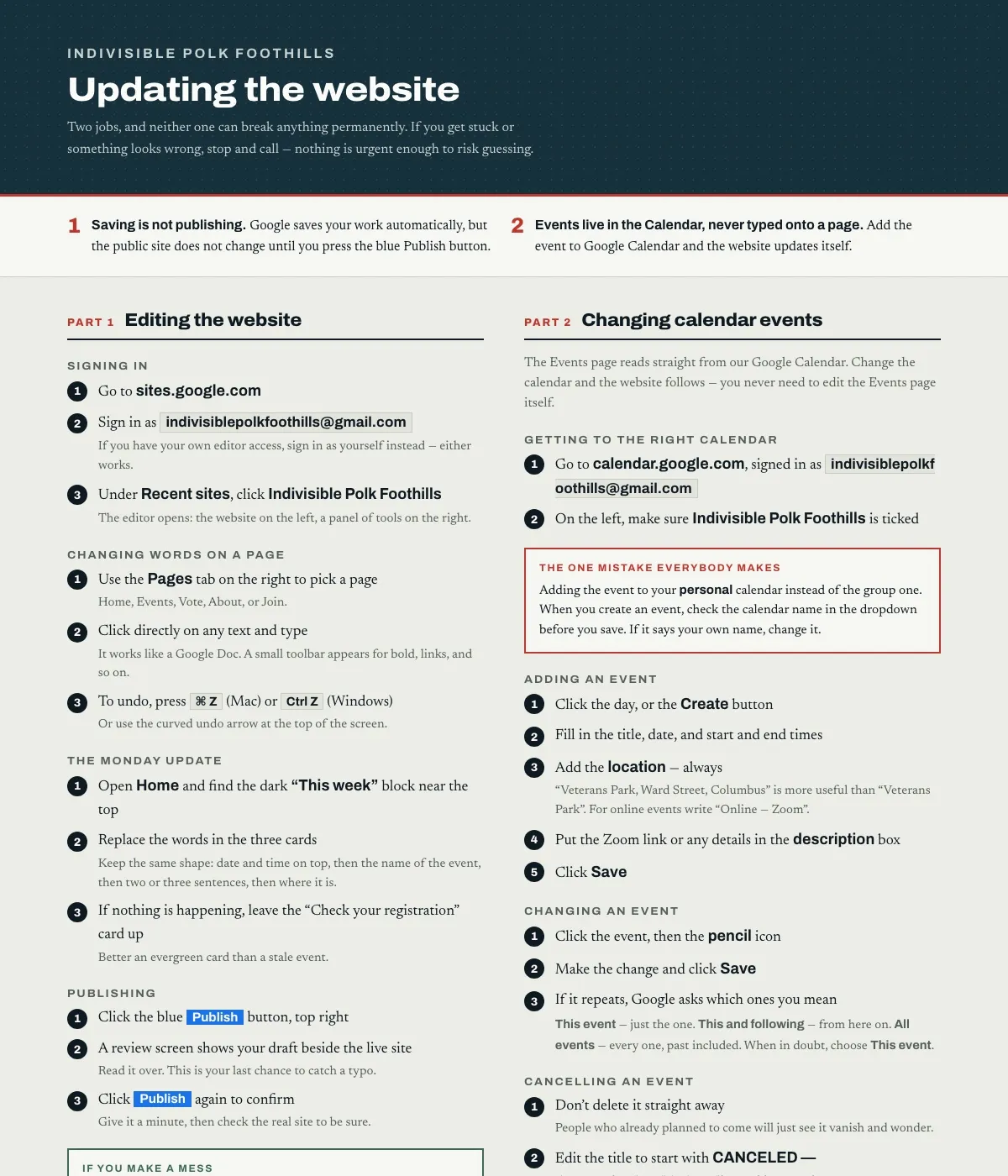
The committee maintains it themselves. They have a one-page printed guide covering the two jobs they actually do — change the words on a page, and change an event in the calendar — and we sat down together and went through it, so the first time anyone published a change was with me in the room rather than alone on a Monday morning.
The guide names the one mistake everybody makes, which is adding the event to a personal calendar instead of the group’s, and shows how to catch it.
There is no retainer and no monthly bill. The site costs them nothing to run, and they do not need me to keep it current.